Most investors think staying on top of their portfolio means checking it constantly. It does not. In fact, one of the most reliable ways to hurt your long-term returns is to watch your investments too closely. The research is clear, and the logic is sound, yet millions of people refresh their brokerage apps every day and wonder why they keep underperforming.
Here is what the evidence actually says, and what you should be doing instead.
Checking Weekly Is a Recipe for Disaster
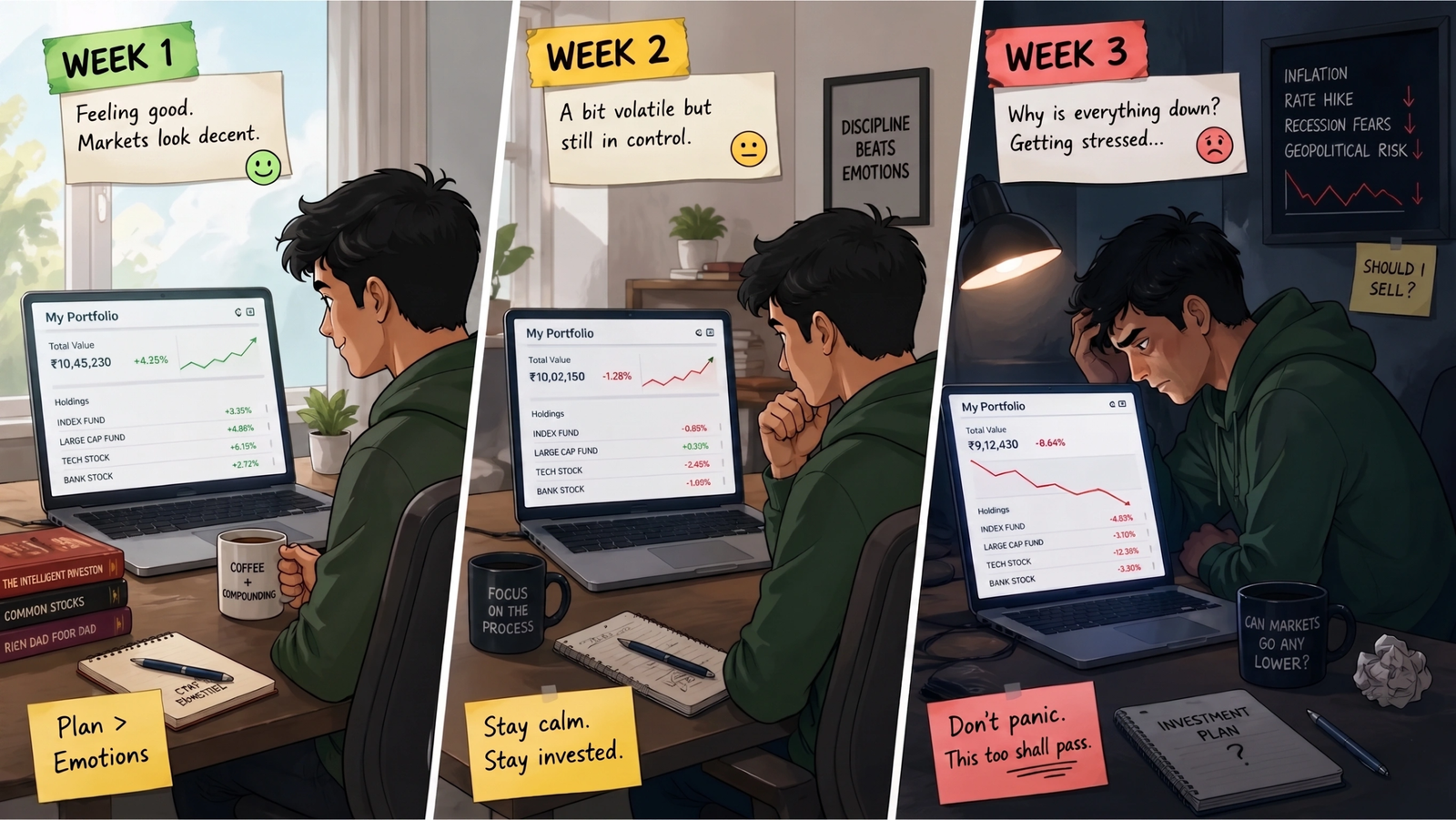
When you check your portfolio every week, you are not getting useful information. You are getting noise. Markets move up and down constantly for reasons that have nothing to do with your long-term financial goals. A bad jobs report, a geopolitical headline, a surprise Fed comment. None of these things changes the fundamental value of a diversified portfolio over a ten or twenty-year horizon. But they absolutely will change how you feel about it.
This is where behavioral finance becomes critically important. There is a well-documented phenomenon called myopic loss aversion, first described by researchers Thaler and Benartzi in the 1990s. The basic finding: losses hurt people roughly twice as much as equivalent gains feel good. When you check your portfolio weekly, you are dramatically increasing the number of times you encounter paper losses, even in an overall upward-trending market. More frequent checks mean more emotional pain, and more emotional pain leads to worse decisions.
Also of Interest
Covered Call ETFs May Be Paying You with Your Own Money
Do you Know What Kind of Investor You Are? Take Our Investor Profile Quiz to Find Out!
How to Create Your Own Custom Stock Screener
A landmark study published in the Quarterly Journal of Economics found that investors who received frequent portfolio feedback took significantly less risk and earned lower returns than those who received infrequent feedback. The frequent checkers were not being more responsible. They were just scaring themselves into making more bad decisions.
Index Funds Already Do the Work For You
Related: (Sponsored Affiliate) Want to find the best Index ETFs? Use this tool to research funds that work for you!
One reason people feel compelled to constantly monitor their portfolios is a sense that something needs to be managed. With individual stocks, that instinct has at least some logic behind it. A single company can collapse overnight. You might want to know.

But index funds are fundamentally different. When you own a broad market index fund, you own a slice of hundreds or thousands of companies across dozens of industries. The diversification is already built in. If one company implodes, it barely registers against the others’ weight. If one sector struggles, others often pick up the slack.
There is nothing to monitor on a week-to-week basis, as the index rebalances itself. Companies that grow automatically become a larger portion of the index. Companies that shrink become smaller. The mechanism runs without any input from you.
Checking weekly is not vigilance. It is just anxiety with extra steps.
Stop Losses: A Sometimes Useful, Sometimes Dangerous Tool
For investors who genuinely cannot stomach the idea of a major drawdown, stop losses are worth understanding. A stop loss is an automatic order to sell a position if the price falls below a specified level. In theory, it caps your downside.
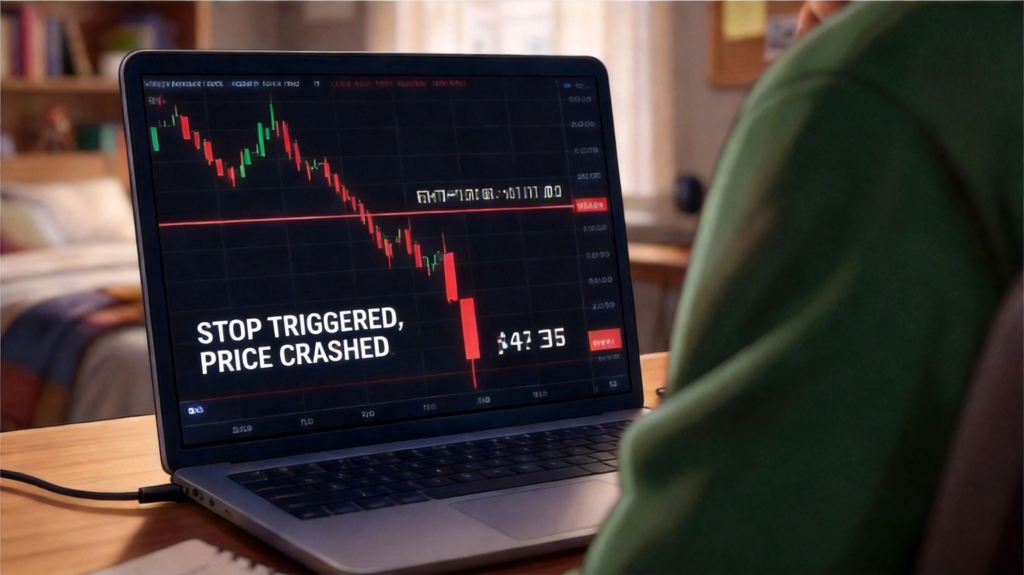
In practice, it is more complicated. During volatile but ultimately temporary market drops, stop losses can trigger at exactly the wrong moment. The 2020 COVID crash saw markets fall roughly 34% in about five weeks before recovering almost entirely over the following months. An investor with a stop loss set at 20% below their purchase price would have been sold out near the bottom, locking in permanent losses and missing the entire recovery.
Stop losses work better for individual stock positions than for diversified index funds, where short-term volatility is almost never a signal of permanent impairment. If you do use them, set them wide enough that normal market fluctuations do not trigger them, and understand that you are trading the risk of a catastrophic loss for the risk of being shaken out at the worst possible time.
They are a tool. Like most tools, they can cause damage in the wrong hands or the wrong situation.
The Research Is Not Even Close: Checking Less Wins
The data on this is remarkably consistent. Study after study finds that investors who trade less frequently earn higher returns. How does this relate to checking portfolios? Investors will likely trade more often when they check their positions frequently.
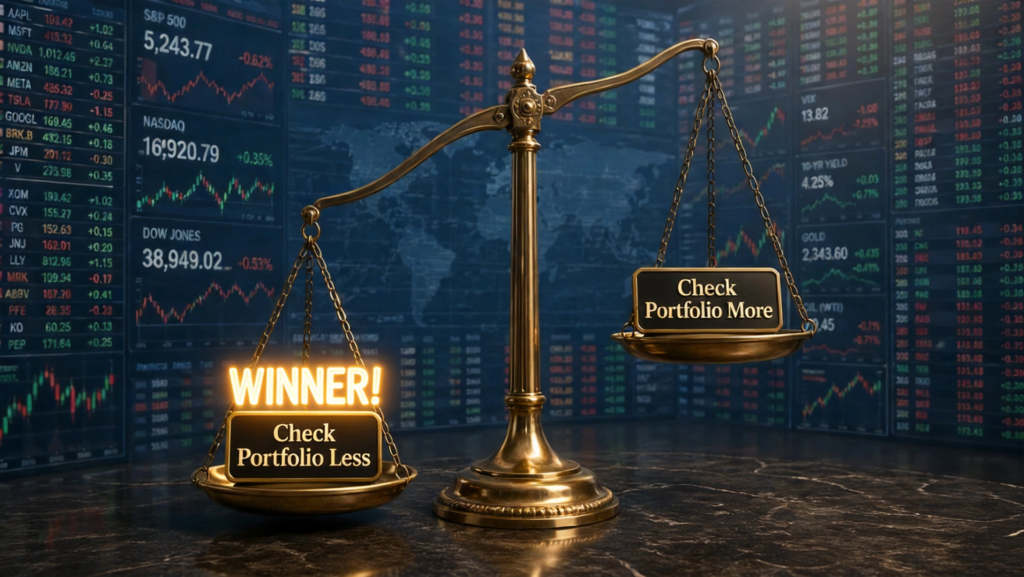
Finance professors Brad Barber and Terrance Odean analyzed the trading behavior of thousands of investors. Their conclusion: more trading led to worse outcomes. The least active traders consistently outperformed. Overconfidence, fueled by continual monitoring, led to costly churn.
Vanguard has published similar analysis showing that investors who made no changes to their portfolios during major market downturns consistently outperformed those who reacted to short-term volatility. Doing nothing, it turns out, is one of the hardest and most valuable things an investor can do.
Warren Buffett has made this point repeatedly in different ways over the decades. His most famous version: the stock market is a device for transferring money from the impatient to the patient.
The Tax Consequences of Overtrading
Beyond the emotional and performance costs, there is a very concrete financial penalty for trading too frequently: taxes.
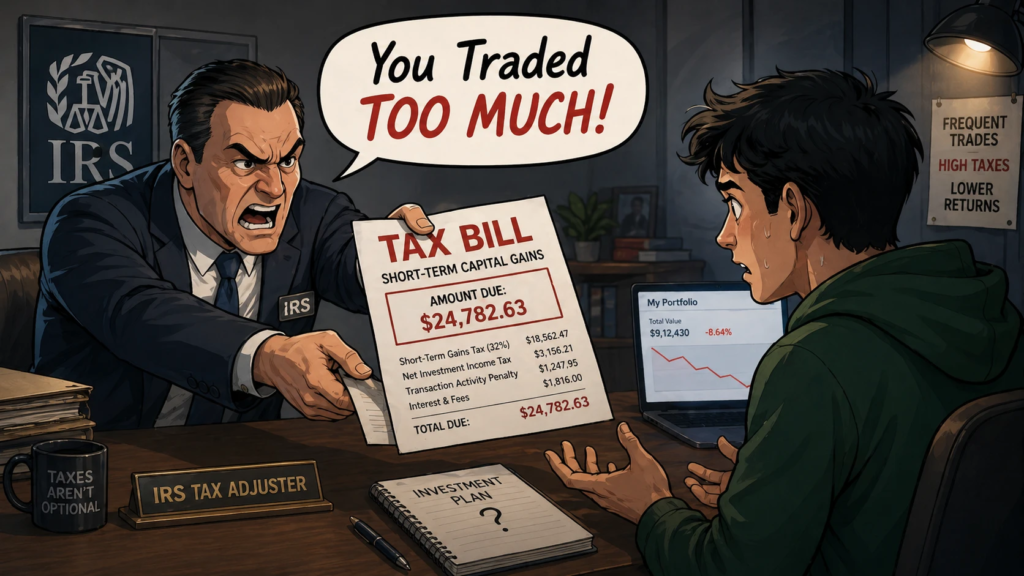
In the United States, investments held for less than one year are subject to short-term capital gains tax, which is taxed at your ordinary income rate. Depending on your tax bracket, that can be anywhere from 10% to 37%. Hold the same investment for more than a year, and you qualify for long-term capital gains rates, which top out at 20% for most high earners and are zero for lower-income investors.
The difference is enormous. An investor in the 32% income tax bracket who constantly turns over their portfolio is handing the government nearly a third of every gain. An investor who holds patiently for years pays a fraction of that. Over decades, the compounding effect of that tax drag is staggering.
There is also the issue of transaction costs, though these have fallen dramatically with the rise of commission-free brokers. Even at zero commission, the bid-ask spread on frequent trades adds up. And every sale resets your cost basis, potentially triggering gains you could have deferred for years.
The tax code is essentially set up to reward patient investors. Frequent checking leads to frequent trading, which leads to frequent tax bills. It is a cost most people never fully account for when they are busy reacting to the latest market move.
Do Rebalance, But on Your Terms
None of this means you should ignore your portfolio entirely. Rebalancing is genuinely important, and there is good reason to do it. The question is how often.
Quarterly, semi-annual, and annual rebalancing are all reasonable approaches. Research suggests that annual rebalancing captures most of the benefit while incurring the least transaction cost and tax friction. More frequent rebalancing tends to generate more taxable events without meaningfully improving outcomes.
What rebalancing actually involves is pretty simple. If your target allocation is 85% stocks and 15% bonds, and a strong equity run has pushed you to 92% stocks, you trim back toward your target. This is the one time you are actually responding to market movements in a structured and intentional way, rather than reacting emotionally to short-term noise.
The keyword is intentional. You set a target. You check it on a schedule. You make modest adjustments if needed. Then you step away again. That is the entire job of active management for a long-term index investor.
Tune Out the Financial Media
This is perhaps the most underrated piece of advice in all of personal finance. CNBC, Fox Business News, and their equivalents exist to generate advertising revenue. Advertising revenue requires viewers. Viewers require engagement. Engagement requires urgency. And urgency, in financial media, means making you feel like something important is happening right now that requires your immediate attention.
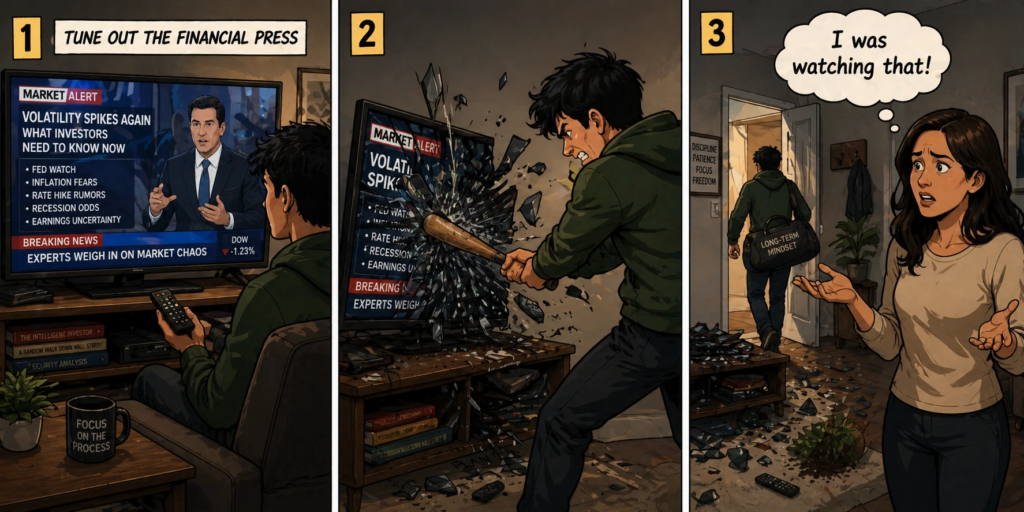
It almost never does.
The financial media machine is optimized to create anxiety. Every market dip is a crisis. Every rally is a bubble. Every Fed decision is a turning point. The commentary is delivered with confidence and authority by people who, study after study has shown, predict markets no better than chance.
There is a famous Philip Tetlock research project called the Good Judgment Project, which found that expert forecasters in finance and economics were consistently and significantly wrong about market calls. The analysts you see on television making confident predictions about where the S&P 500 will be in six months are, statistically, guessing.
More troubling is the incentive structure behind financial media commentary. Advertisers on these channels are often brokers, fund companies, and financial services firms. Their businesses benefit when you buy and sell. A guest saying “hold your index funds and do nothing for the next decade” is not great for ratings or for the advertisers paying the bills. So that guest rarely appears.
The commentary is not designed to make you wealthy. It is designed to make you watch. The two goals are almost perfectly opposed for a long-term passive investor.
Turn it off. Or watch it the way you would watch a weather forecast for a city you have no plans to visit. Mildly interesting, completely irrelevant to your decisions.
The Bottom Line
Key takeaways: Avoid weekly portfolio checks, as they increase anxiety rather than performance. Let index funds do the work by minimizing trading to reduce taxes and losses, staying patient, and limiting exposure to financial media, which rarely helps long-term outcomes.
Set your allocation. Rebalance once or twice a year. Ignore the noise. Let compounding do its work.
The investors who come out ahead over decades are almost never the ones who were most engaged day to day. They are the ones who were disciplined enough to mostly leave things alone.
That is not a passive strategy. It is actually one of the hardest things to do in investing. But the evidence is overwhelming that it works.


Be First to Comment