
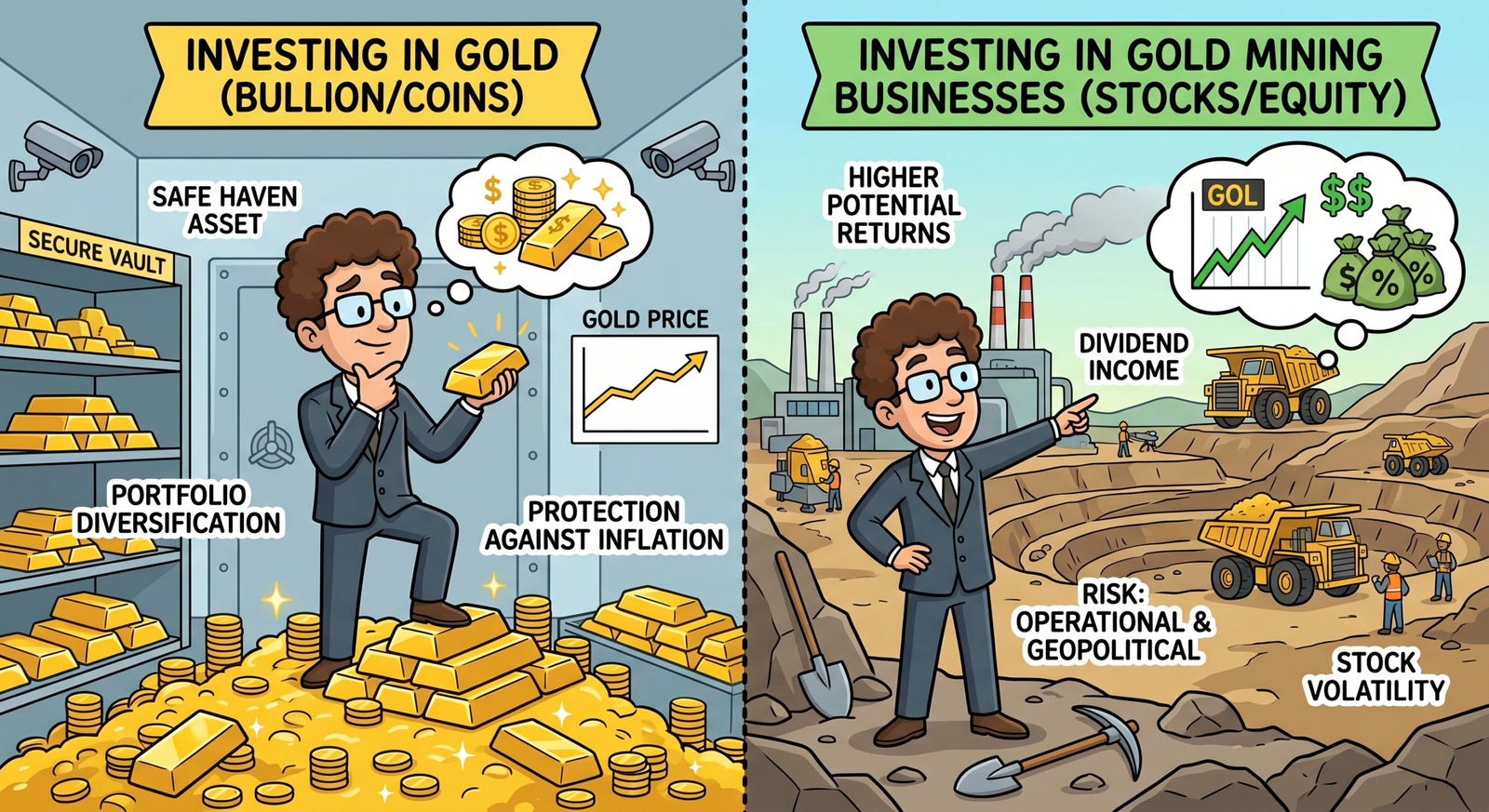
When someone says, “I’m thinking about investing in gold,” the first thing to ask is:
What do you actually mean by gold? That might sound like a strange question. After all, gold is gold, right?
Not exactly.
Some investors buy physical gold coins and bars. Others buy exchange-traded funds that track gold prices. Still others buy shares of companies that mine gold. While all three are connected to the precious metals market, they behave very differently.
In fact, many investors who think they own a “gold investment” are often surprised when it doesn’t perform the way they expected. Knowing the difference can help you avoid disappointment and, more importantly, pick the kind of investment that fits your goals.
There is also another lesson hidden beneath the surface here, one that applies not just to gold, but to every investment decision you make.
We’ll return to that idea soon.
The First Question: What Job Are You Hiring Gold To Do?
Before we talk about gold itself, let’s think about purpose.
If you are hiring an employee, you wouldn’t hire a carpenter to do accounting. Nor would you hire an accountant to build a house. Both might be great at their jobs, but they have different roles. It’s the same with investments. One of the biggest mistakes investors make is buying something without first deciding what they want it to do in their portfolio. When investors say they want exposure to gold, they are usually trying to accomplish one of several things:
- Hedge against inflation
- Protect wealth during uncertainty.
- Diversify a portfolio
- Speculate on rising gold prices.
- Generate long-term capital appreciation.
- Seek leverage from rising metal prices.
The issue is that different types of precious metals investments are better at different things.
Investing in Gold Itself
When most people think of gold, they imagine coins, bars, or maybe an ETF that follows the price of gold. These investments are tied directly to the underlying metal.
If gold goes up by 10%, your gold holdings should usually rise by about the same amount, minus any expenses or small tracking differences. The idea behind this kind of investment is pretty simple:
If demand for gold increases or investors seek safety, the price of gold may rise.
Gold itself does not produce earnings or manufacture products and, by itself, does not generate cash flow. Gold is often viewed as a store of value rather than a productive asset.
Why Investors Buy Gold
Investors commonly purchase gold because they believe:
- Inflation may erode purchasing power.
- Currency values may weaken.
- Financial markets may become unstable.
- Governments may increase debt levels.
- Geopolitical risks may increase.
Here’s something important to notice. None of those reasons requires having a business. People who buy gold are usually more focused on protection than on growth.
Investing in Gold Mining Companies
Now let’s look at gold miners instead. A gold mining company is not gold; it’s a business, and it is crucial to understand the difference. When you buy a mining company, you are purchasing a stake in an operating enterprise that:
- Hires employees
- Purchases equipment
- Manages costs
- Acquires land
- Explores for new deposits
- Raises capital
- Makes strategic decisions
The price of gold is very important to miners, but it’s just one of many things that affect how well they do.
A Simple Example
Suppose gold rises from $2,500 per ounce to $3,000 per ounce. At first glance, you might assume a gold miner would rise by the same amount. But miners often experience boosted results.
Imagine a miner produces gold at a cost of $2,000 per ounce.
At $2,500 gold:
- Revenue per ounce: $2,500
- Cost per ounce: $2,000
- Profit per ounce: $500
Now gold rises to $3,000.
- Revenue per ounce: $3,000
- Cost per ounce: $2,000
- Profit per ounce: $1,000
Gold increased 20%.
Profit increased 100%.
That operating leverage is one reason mining stocks can sometimes dramatically outperform the metal itself. But there is another side to that equation.
The Risk Side
Suppose gold falls, or energy costs rise. Alternatively, mines can experience production issues. The business can make bad decisions,, or the government can regulate mining in ways that hurt business performance.
Now the mining company might struggle even if gold prices stay about the same. Unlike gold itself, mining companies carry business risk. Investors sometimes forget this because they only focus on the price of gold.
Why Gold Miners Can Underperform Gold
Many investors are surprised when gold reaches new highs while mining stocks lag behind. This happens more often than people realize. A mining company’s stock price depends on factors such as:
- Production growth
- Reserve quality
- Management decisions
- Debt levels
- Political risk
- Labor costs
- Fuel costs
- Environmental compliance
- Capital allocation
Gold itself can be doing what is expected, while the mining company is having a tough time.
Here’s another way to look at it. Buying gold is making a statement about gold. But buying a mining company is making a statement about management’s ability to run a profitable business that happens to produce gold.
These are two different ideas.
Which Type of Investor Prefers Gold?
Many investors who favor physical gold or gold-backed funds tend to value:
- Capital preservation
- Portfolio diversification
- Lower operational risk
- Simplicity
They often see gold as a kind of insurance. Nobody buys homeowners’ insurance hoping their house burns down. Likewise, many gold investors are not necessarily hoping for financial turmoil.
They just want protection in case something does happen.
Which Type of Investor Prefers Gold Miners?
Mining investors often have a different mindset. They are likely seeking higher growth potential and greater upside leverage. Furthermore, they seek income through dividends. The ideal situation is to discover more mining hot spots, which can help the company outperform the metal itself.
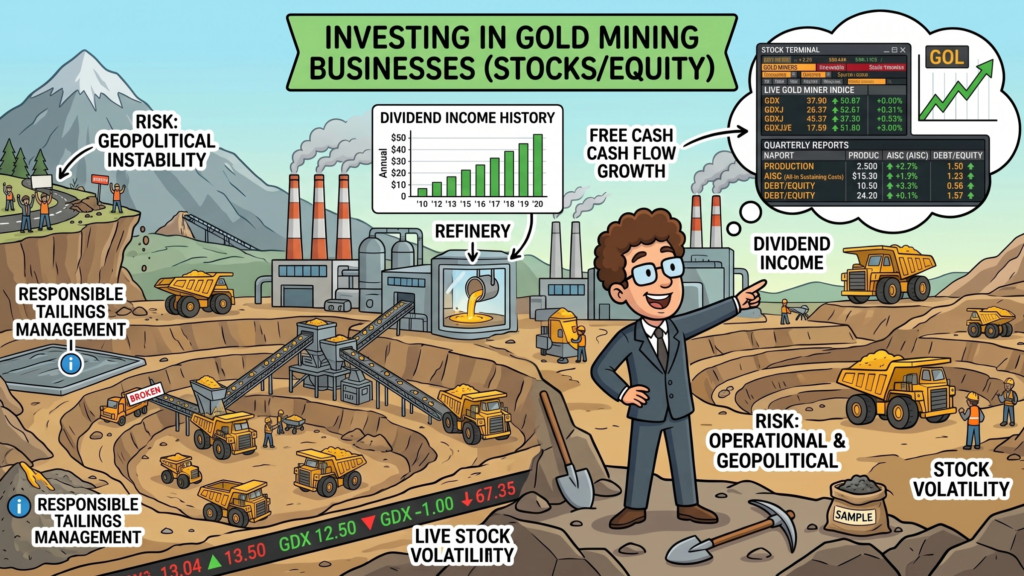
These investors are usually more comfortable looking at businesses and their numbers. They may review financial statements, production reports, reserve estimates, and management quality. Their investing thesis is not merely that gold will rise. They want to know if the business will create shareholder value.
The Hidden Question Most Investors Miss
Which one is better for me?
This is where a lot of investors get stuck. They spend countless hours researching investments without first understanding their own investing tendencies.
Some investors genuinely sleep better knowing they own stable, diversified holdings. Others enjoy researching companies and accepting more risk in exchange for potentially higher returns.
Neither approach is inherently right or wrong.
The real mistake is choosing a strategy that doesn’t align with your personality and investor profile. An aggressive growth investor may become frustrated holding conservative assets, while a conservative investor may become anxious about owning highly volatile mining stocks. The mismatch is often what causes problems.
The Precious Metals Lesson Applies Everywhere
The difference between gold and gold miners is really a lesson about investing in general. The same concept appears in countless areas:
- Bonds versus dividend stocks
- Index funds versus individual stocks
- Large companies versus small companies
- Real estate versus REITs
- Growth investing versus value investing
Every investment carries an underlying assumption. And every investor carries an underlying personality. The more those two things align, the more likely you are to stick to your plan during tough times, which helps you stay committed.
Final Thoughts
Gold and gold miners might look similar at first, but they are actually very different investments. Gold itself is often used as a store of value, a hedge, or a diversification tool. Gold miners are operating businesses whose fortunes depend on both gold prices and management execution.
Neither is automatically better than the other, and each serves a different purpose. The real challenge is determining which purpose aligns with your goals and risk tolerance.
It’s interesting that most investors spend years learning about investments, but hardly any time learning about themselves. Maybe it should be the other way around.
If you’ve ever wondered why some investments feel comfortable, and others keep you up at night, there’s probably a reason for that. Before you make your next investment decision, it might help to find out if your natural investing habits are affecting your choices more than you think.
You can explore that idea here:
You might be surprised by what you find.

Be First to Comment