

With all the hype surrounding the SpaceX IPO, individual investors can be forgiven for experiencing FOMO (fear of missing out). But will you actually benefit from any purchase you make during an IPO?
The allure is understandable. After all, the media keeps telling us that $SPCX made Elon Musk the first trillionaire. And many insiders became multi-millionaires, if not billionaires.
Before you close out all your bank accounts to buy $SPCX, you should consider what the most famed investor, Warren Buffett, and his mentor, Benjamin Graham, had to say on the topic.
What Warren Says…
Warren Buffett’s net worth has been built via his long-term holdings. He wasn’t a fan of IPOs, and this is what he said about them:
“It’s almost a mathematical impossibility to imagine that, out of the thousands of things for sale on a given day, the most attractively priced is the one being sold by a knowledgeable seller to a less-than-fully-informed buyer.”
Buffett supposedly never purchased shares of an IPO. He allows companies to build a strong track record in the market before he’ll even consider them. Often, the time horizon can be more than a year away.
It’s rare for an IPO to offer anything other than inflated prices. Buffett is a value investor, and there is no value in stocks priced above intrinsic value. It’s also difficult to determine the intrinsic value of an IPO, since it has no history as a publicly traded company.
Benjamin Graham, who was Buffett’s mentor, had an even stronger dislike for IPOs. Graham observed that IPOs often occurred during the giddy days of bull markets, when everyone was in a buying mood. This mindset, of course, drives prices higher extensively.
Graham also noted that the history of new issues follows a treacherous pattern for most investors. Early investors, i.e., institutions, venture capitalists, and insiders, capture the bulk of the gains. The individual investors are left holding the bag at the top of the market.
He is also known to say that the more euphoric the marketing hype, the more skeptical individual investors should be. Investment banks get paid big bucks to hype the IPOs like they are the second coming.
What the Data Shows
Empirical evidence largely supports Buffett and Graham’s instincts. Studies have consistently found that IPOs, as a class of investment, tend to underperform the broader market over the medium and long term. The short-term “IPO pop” on the first day of trading often reflects institutional investors locking in quick profits, not the creation of lasting value for ordinary shareholders.
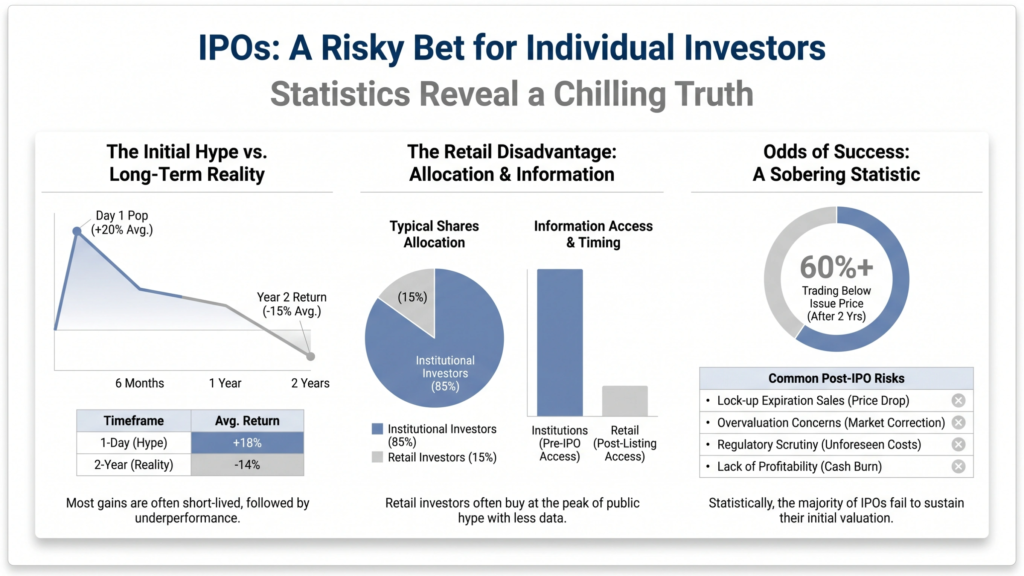
A famous study by Jay Ritter, a finance professor who has tracked IPO performance for decades, found that companies going public have historically underperformed comparable non-IPO stocks over the three to five years following their offering. The excitement of opening day rarely translates into durable outperformance.
Ritter, Jay R. “The Long-Run Performance of Initial Public Offerings.” The Journal of Finance, Vol. 46, No. 1, March 1991, pp. 3–27. https://doi.org/10.1111/j.1540-6261.1991.tb03743.x
A more recent study by Ritter covering IPOs from 1980 to 2019 confirms that pattern repeats in two-thirds of IPOs tracked. These IPOs trail the market by over 10% for over three years after going public in many cases.
Ritter, Jay R. “Initial Public Offerings: Updated Long-Run Statistics.” University of Florida, Warrington College of Business (updated through 2025). Available at: https://site.warrington.ufl.edu/ritter/files/IPOs-long-run-returns-on-IPOs.pdf
Some IPOs have been successful and have done well for all investors right out of the gate. But there are no indicators that can identify these in advance. Since the odds are against successful IPOs for individual investors, most may want to lean on those odds and skip IPOs altogether.
What Can Be Done?
IPOs have a lockup period, which prevents investors from buying and, soon after, selling their shares when the price advances due to hype. When the lockup period expires, IPO IPO shares often go into a tailspin. It’s difficult for individual investors ot play fast-moving situations like the post-lockup selloff.
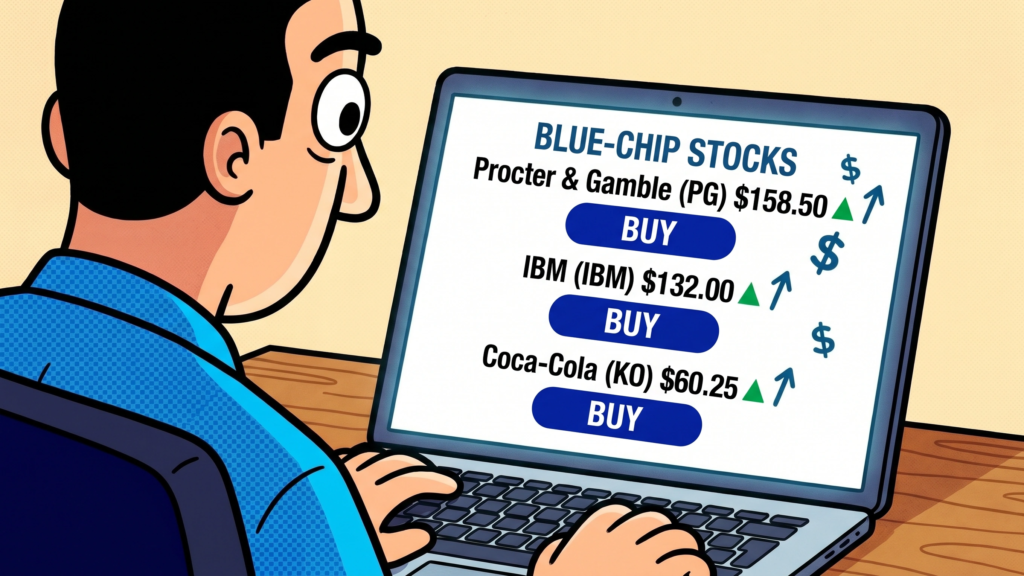
Many investors keep the IPO on their watch list and sometimes even wait a few quarters to see how Wall Street reacts to events related to the IPO. Remember that investing is supposed to be for the long term. If the company is a dud, you’ll know that when the dust settles.
You likely would not have received the number of shares you requested. Therefore, the opportunities you think you will lose because you only received a few shares won’t be as impactful.
Another option is to consider that many other companies in the market have established histories. While FOMO on IPOs may cloud your judgment momentarily, keep in mind that you are in the driver’s seat when it comes to picking out companies to buy. IPOs are not the only means to make money in the stock market.
Investor Profile Quiz
Disclaimer: This quiz is for educational purposes only and does not constitute financial, investment, or tax advice. Results are general in nature and are not a substitute for advice from a qualified financial professional. No answers or results are recorded or stored - everything is calculated in your browser.
Disclaimer: This result is for educational purposes only and does not constitute financial, investment, or tax advice. Please consult a qualified financial professional before making investment decisions.

Be First to Comment