

Oct 11, 2026 · @James Cochrane
Every dollar you invest is a dollar you cannot invest anywhere else, and the best businesses understand this better than anyone. The strongest companies are not simply the ones that work hard or grow fast. They consistently put their capital into assets that earn more than the alternatives.
Site owner may receive a commission from purchases made through links on this page, with no extra cost to you.
This concept also applies to investors. How many times have you bought a stock and it either went down or stayed flat, while another investment you were considering shot into the stratosphere? This concept is called opportunity cost.
Is Opportunity Cost a Real Situation?
Opportunity cost is the value of the next-best option you gave up when you made a choice. It rarely shows up on a statement, which is exactly why it is so easy to ignore. You never receive a bill for the return you missed.
Let’s go through an example. Suppose you have $10,000 and put it in a savings account earning 2%. After a year, the investment is worth $10,200. Even though you gained, you may still have lost compared with other investments. But if a comparable-risk alternative earned 10%, your choice cost you $800 in that year alone.
Sometimes, you may need to accept lower returns. If market conditions worsen, investors often aim to stay above zero. Any excess return over that is gravy.

You need to evaluate the investment performance against your goals. If you meet your goals, you can chalk it up as a win (more on this next).
How great business owners think about it
Good operators live and breathe opportunity cost, even if they call it something else. When a company has extra cash, management can build a new factory, buy a competitor, repurchase shares, pay down debt, or return money to owners. Managers compare each option against the others.
Because managers are under pressure to meet sales goals, they set targets and compare returns measured against them. They evaluate what they got right and how to improve when sales don’t go as planned. This is how they improve their forecasting.
If you, as an individual investor, set target returns, your investment results will improve over time through higher-quality research. You’ll never get to 100%, though. So don’t bother trying.
How opportunity costs affect individual investors
There are three common ways investors pay opportunity cost without noticing:
- Holding a lagging stock out of habit. You bought it years ago, it has gone nowhere, and selling feels like admitting a mistake. But the question is not what you paid. It is whether this is still the best place for that money today.
- Sitting in cash or low-yield assets too long. Safety has a price. Over long periods, money parked in low-return assets can fall far behind money invested in productive businesses.
- Spreading money across too many ordinary ideas. Owning a little of everything can dilute the impact of your best ideas. Your best opportunity deserves more of your attention than your 40th best.
When not to go overboard with opportunity costs
If you earn less on one investment than on the one you didn’t pick, you’ll likely be upset about it. But unlike a business manager, you won’t lose your job over it. But if you become obsessed with finding the absolute best returns, you’re likely to compromise them through compulsive actions. You risk investing too much money, thinking you’ll score big by allocating more to a trade.
You may also start investing in riskier stocks because you’ve heard that bigger risk = bigger gain. But risk works both ways, and bigger risk means more money lost when the trade goes against you.
Seeing the opportunity cost with the Growth of $10K feature
Here is a routine you should work into your daily investing research. Find three somewhat related stocks, for instance, in the same industry or as competitors. Try to find five comparable stocks. Then use Stock Analysis’ Growth of $10K feature in the comparison as well.
Here is the Growth of 10K tool preconfigured.
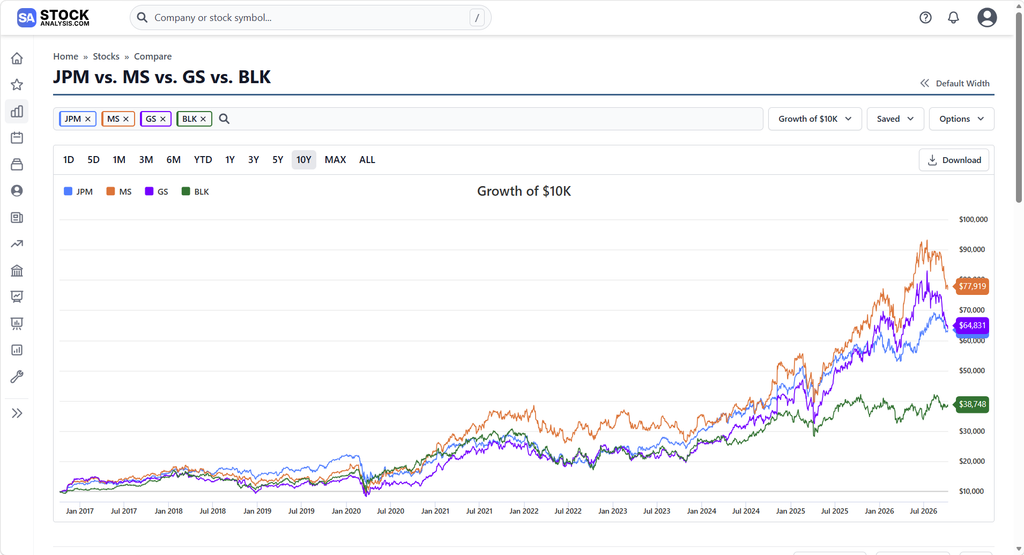
In the example above, you may feel (as I do) that $BLK doesn’t belong in this comparison, and that Citibank ($C) is a better choice. If so, delete the BLK object and type in the letter C to add Citibank to the list:
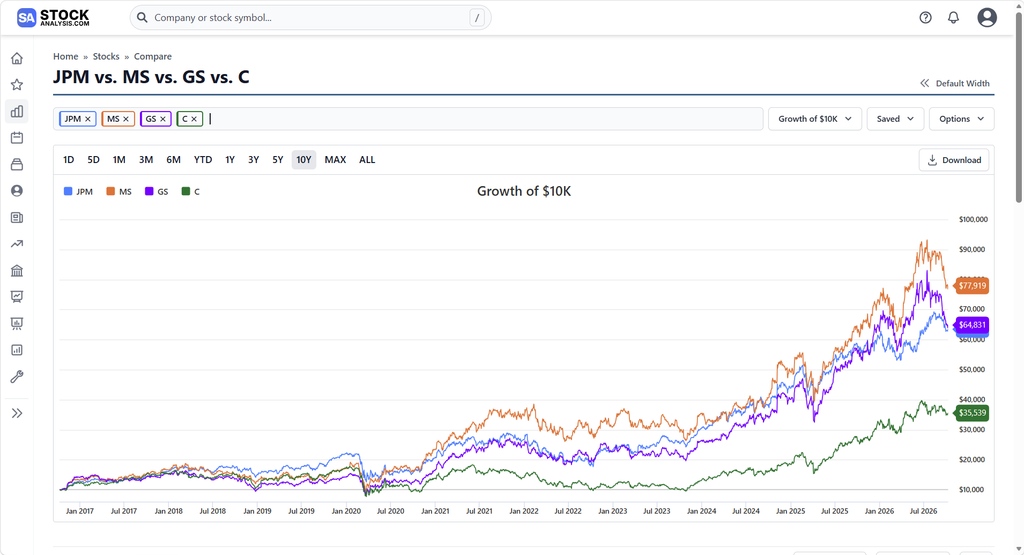
Alternatively, you could research the four or five stocks you found (you can use Stock Analysis for that, too) and determine which is likely to win (in terms of the largest dollar amount) when you enter them into the Growth of $10K feature.
Be aware, however, that the $10K measurement is based on the stock’s past performance. Although historical research is available in Stock Analysis, the majority of the research items will be for the current quarter or year (or TTM). It won’t be a completely accurate test, but it will get you used to doing research in a fun manner. And when you pick stocks with better current fundamentals, a good company likely had the same good fundamentals in the past. So the exercise is useful for a lot of reasons.
The bottom line
The best business owners win by buying the assets that return the most and selling the ones that don’t. Investors can do the same. Treat every holding as a competitor for your next dollar, measure it against its alternatives, and be willing to reallocate when a better use of capital appears. Opportunity cost never sends a statement, but over a lifetime of investing it may be the largest number you pay.






Be First to Comment